Why This Matters If You Own—or Plan to Build—a Website
If you're on this page, chances are you've asked yourself at least one of the questions below.
What Is SEO and Why Does It Exist?
People keep telling me they can get my website to rank at the top of Google.
How does that work? What does it cost?
Lately, there's been a lot of buzz around GEO and how many websites will need to be rethought or adapted to communicate properly with AI-powered search systems. Right now, these techniques are mostly being used by big companies or teams with strong technical expertise.
GEO — Generative Engine Optimization — is the set of practices that helps website content become clearer, easier to understand, and more usable by AI-powered search systems. It doesn't replace SEO: it starts from the same foundations and aims to make information, entities, and relationships easier to interpret in generative search as well.
But how does it actually work? Can I use it too? And if so, what's it going to cost me—and what kind of real-world results can I expect?
Whether you're a small business owner who doesn’t know much about search engines, or a seasoned pro already working with JSON-LD, semantic graphs, and experimental AI attributes—I'm going to answer the most common questions by organizing this content into four levels, so everyone can quickly find what they need.
Who This Article Is For
Table of Contents — Click to Open
If you want, you can use the table of contents below to jump straight to the section you're most interested in.
I'll start with a brief history of how the need for SEO emerged and why Google kept adding new rules to improve the quality of search results and make the old tricks used to manipulate rankings less and less effective.
In Section 2, I'll speak to folks who feel like they have to learn Arabic when it comes to tech—but who still need to grasp the basics because they've got a website and want it to succeed for their business. I'll stick to dead-simple examples to help them understand what really matters.
If you're an intermediate user or a web designer just starting out, skip to Section 3, where I explain in more detail what E-E-A-T means, how to build signals of experience, expertise, and trustworthiness, and how SEO and structured data can help make this information clearer.
Finally, if you're a fellow expert who hand-codes your own JSON-LD or generates it dynamically via PHP, jump straight to Section 4, where you'll find more technical language about generative search, JSON-LD, crawling, AI systems, and experimental AI-specific attributes.
Who's Writing This?
Before I explain how SEO was born and why it evolved, let me introduce myself briefly.
My name is Roberto Bianchi, and back in 1997 I was already building websites using JavaScript to bring websites to life. At the time, I was living in Finland.
A site I built back then caught the attention of KONE Oyj (KONE Corporation), and they offered me a position as head of the company's worldwide intranet—at the time connected to several thousand terminals around the globe.
Before long, I became the system administrator for the platform the company used to manage industrial designs.
At the same time, I also became an internal trainer. Between 1998 and 2002, I traveled the world for KONE: Italy, France, Finland, and the US.

I've been living back in Italy for a few years now:
- In 2022 I earned my TEFL OFQUAL Level 5 teaching certification
- In 2024 I opened my own company, Global Digital Web di Roberto Bianchi—I offer consulting, build websites (only for clients I carefully select), and teach technology in English for the European Union's Erasmus+ program
Titles aside, I’ve always been genuinely passionate about technology. And I feel like I can offer some solid advice to anyone who wants to know more.
Section 1 - The History of SEO
In the ’90s, you could trick search engines with some pretty cheap tactics. Today, Google uses much more sophisticated systems to evaluate the quality, usefulness, and reliability of content. In this section, I'll walk through almost 30 years of SEO evolution: from white text on white backgrounds to the updates that gave us E-E-A-T—told from the perspective of someone who lived through these transformations firsthand.
The World Before Google: AltaVista and Netscape
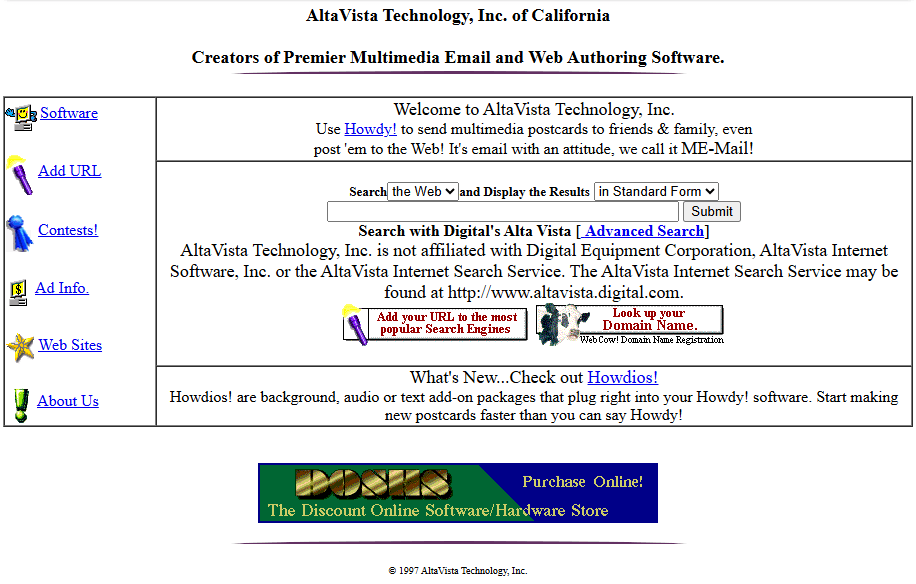
Let's start in 1997, when Google didn't exist yet.
Back then, the internet landscape looked very different from today:
- The go-to search engine was called AltaVista
- One of the most popular browsers was called Netscape
- Many web pages were still written by hand—today's page builders didn't exist
Meanwhile, between 1996 and 1997, two guys were laying the groundwork for what would become the most powerful search engine in history: Larry Page and Sergey Brin, building it at Stanford.
The Birth of SEO: How It All Started
Right around 1997, the term SEO started making the rounds—it basically meant "let's learn how to make our site show up better when people search for something."
(source: The history of SEO)
To get found on AltaVista, there were several tricks. One of the most common was repeating your most important keywords hundreds or even thousands of times, with white text on a white background or shrunk down until it was practically invisible.
Imagine writing your store's name a thousand times on a white piece of paper with a white marker. People who walk into the store can't see anything—but the search engine could still read those words and consider them in the ranking.
Warning! These were tricks from almost 30 years ago. Today they're considered black hat practices and can hurt your rankings.
In 1998, while I was working at KONE, I still remember my colleague Jorma Heimonen—the resident genius at the time—who said to me:
"Roberto, have you tried using Google instead of AltaVista?"
I started using it right away. A few years later, in April 2004, I was also among the first to use Gmail. I still use that email address today.
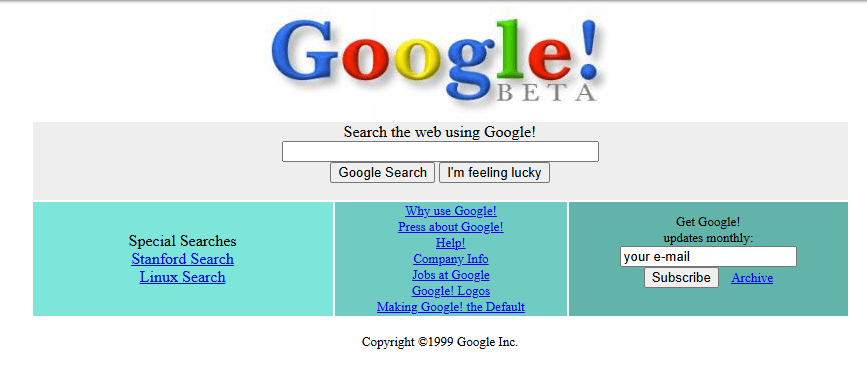
Here's a screenshot of Google in 1999 when it was still in BETA.
Google's First "Roadblocks": Stop Playing Games
Google was growing fast. In November 2003, one of the first major updates to really shake up the SEO world arrived.
Something worth knowing: Google updates have often been identified by code names—often names of animals, places, or seasons. Kind of like how meteorologists name hurricanes. Whenever you hear one of these names, you know Google has changed something important in its systems.
In the SEO community, that update was given the name Florida, and for many webmasters the message was clear: "Stop playing games!" Many sites that depended on old tricks suddenly lost rankings.
It was a shock: tons of webmasters woke up to find their sites had plummeted in the search results.
Many kept focusing on metadata—information in the page code that visitors normally never see. And that got abused too with what's called keyword stuffing, cramming the meta keywords with words repeated endlessly.
Imagine opening a restaurant menu and finding the word "pizza" written four hundred times. You'd immediately know something's fishy—and Google learned to spot that too.
In September 2009, Google closed that chapter for good: the keywords meta tag wasn't used for web search ranking and had already been ignored for years. (source: Google Does Not Use the Keywords Meta Tag)
And Google didn't stop there.
Panda, Hummingbird, and the Quality Years
In February 2011, Panda arrived—an update that hit low-quality, duplicate, mass-produced content or content with little real value for readers especially hard.
Think of Panda as a health inspector at a restaurant: anyone serving poor-quality food started having problems. Those offering something genuinely useful had a much better chance of getting through it.
Anyone running content farms saw their rankings collapse.
But this wasn't enough for Google, so in 2013 came Hummingbird. Google started going much further than simply matching individual keywords, trying to better understand the overall meaning behind the question.
Before, it was like a librarian searching for books mostly by exact title and specific words. With increasingly advanced systems, it became more like a librarian who understands what you actually want to read.
In practice, it became more and more natural to talk to Google like you'd talk to a person, instead of building artificial searches around keywords alone.
If you searched for "how to make a fluffy chocolate cake," Google increasingly tried to understand the intent behind the question, not just find pages containing those exact words.
That's when writing natural, clear content organized in a logical way became even more important.
And while everyone scrambled to adapt, Google was already preparing the next move.
(source: Google Hummingbird)

2015: Mobilegeddon Arrives—Does Your Site Work on Mobile?
On April 21, 2015, one of the most important changes in SEO history arrived: the infamous Mobilegeddon.
If you opened your site on a phone and found tiny text, elements too close together, or a page that didn't display properly, you could lose visibility in mobile SERPs.
Google made the rules and you had to comply (and be assimilated) 🙂 or risk staying invisible in Google's search engine.
Until then, the focus had been mainly on building sites for desktop. From 2015 onward, it became increasingly important to build them properly for mobile devices too.
The word "responsive" had already been around for a few years, but from that point on it became increasingly important. It means a site that adapts its layout to smartphones, tablets, and computers, like in the example photo.
Today, a non-responsive site signals skills that aren't aligned with the minimum standards of modern web.
Be careful with the “my nephew builds websites” for €300 approach—and then the site is a disaster on mobile.
With the mobile problem solved, Google asked itself an even tougher question: "Okay, the site looks good on phones—but does whoever wrote it actually know what they're talking about?"
E-E-A-T and Helpful Content: Google Likes Professionals Who Actually Know Their Stuff
In August 2018, an important algorithm update arrived that the SEO community nicknamed the Medic Update, because it had a strong impact on many medical and health-related sites.
During those years, the importance Google placed on the expertise and trustworthiness of those publishing content became increasingly clear. Today, these concepts are summarized by the acronym E-E-A-T.
The concept of E-E-A-T isn't a single ranking factor, a public score, or a certification you get by adding structured data. What matters instead is real experience, demonstrable expertise, and reliable, verifiable information.
We do the same thing ourselves. Before paying to see a doctor, we ask around for reviews and want to know whether that doctor really is who they say they are and, if possible, where they studied, how many years they've worked in their field, and what patients and other doctors say about them.
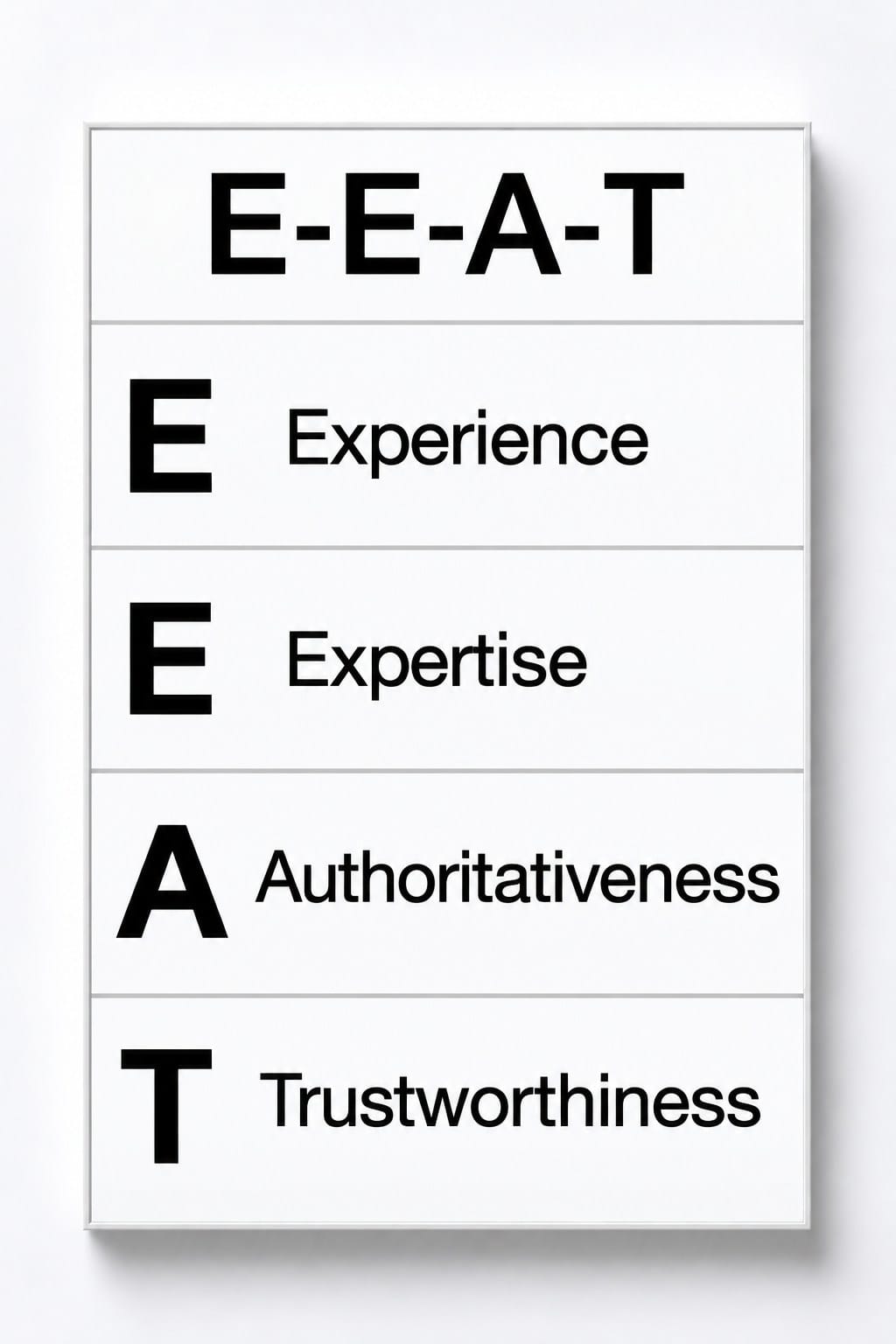
Google thinks the same way about websites.
| Letter | Meaning | In plain English |
|---|---|---|
| E | Experience | Have you personally lived what you're talking about? |
| E | Expertise | Are you actually knowledgeable on the topic? |
| A | Authoritativeness | Do others recognize you as an expert? |
| T | Trustworthiness | Can people trust what you write? |
The full acronym with the double E arrived in December 2022, but the concepts of expertise, authoritativeness, and trustworthiness had already been around for years.
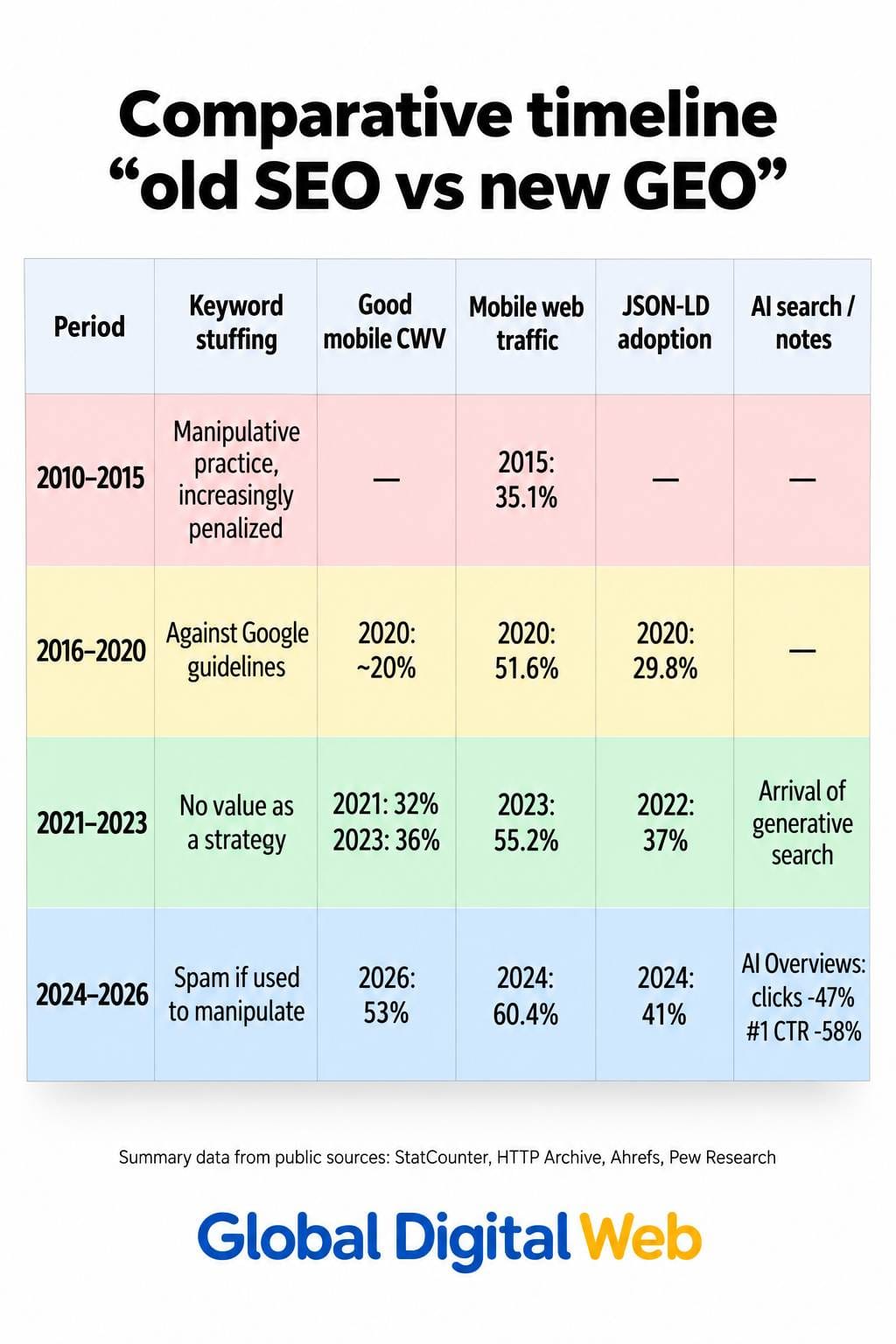
The Moral of the Story
So now you see why Google has kept making SEO more and more complex? On one hand, it pushes people to produce higher and higher quality content. On the other, it tries to weed out those who churn out copy-paste content at scale.
In 1997, you could cheat with cheap tricks. Today? No way. No more shortcuts.
What does the near future hold? I'll talk about that below—in simple, intermediate, or expert-colleague versions.
Section 2 - For Non-Technical Folks: What Is GEO and Why It's Changing the Future of Search
- People don't search the way they used to: they ask questions directly to AI.
- If you've got a website, today it's not enough for it to look good—it needs to be understandable to AI.
- In this section, I'll explain what Generative Engine Optimization is in simple terms, with practical examples and no jargon.
- The goal is to help you understand what's changing and what you can actually do about it.
But… You’ve Been Using It All Along
"Siri, where can I find a seafood restaurant nearby with good reviews?" "Hey Google, which pharmacies are open right now?"
Remember the first time you asked a question like that?
Even though AI exploded into the mainstream between late 2022 and 2023 with ChatGPT, we'd been using it for years without realizing it.
Why does this matter if you run a business and want a website that actually works? Because the way websites used to get found was simple: write a title, some subheadings, and some text, and search engines like Google and Bing decided who had the best answer. But things have changed drastically.
A Real Example: The Seafood Restaurant
Let's go back to that earlier question: "Siri, where can I find a seafood restaurant nearby with good reviews?"
People don't search on Google the way they used to. More and more, people let AI help them decide where to go, what to buy, and who to trust.
(source: How AI features work in Search)
To answer a question like this, a system can use the online menu, the business profile, and available reviews. Which sources it checks depends on the system and the question: it doesn't necessarily know which dishes customers prefer or compare every review.
Detailed information obviously helps, but it doesn't guarantee an accurate judgment about the restaurant's quality.
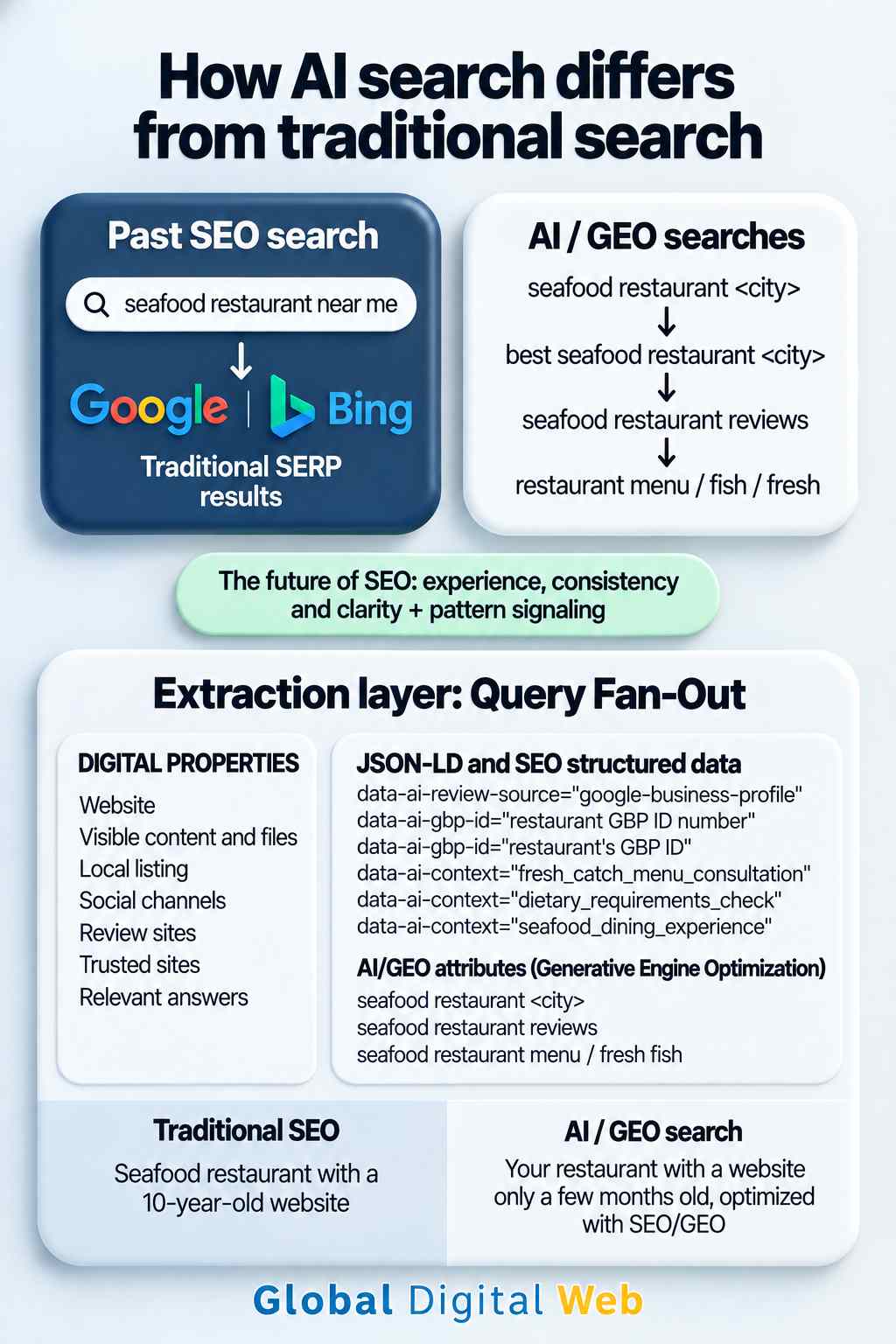
Think of AI as a friend who knows every restaurant in town and immediately looks for useful information whenever a new one opens.
If it wants to give you solid advice, it needs detailed, reliable information—not just a sign that says "seafood restaurant."
Whoever builds the site can connect it to the restaurant’s Google Business Profile and any Yelp or TripAdvisor profiles, keeping the information consistent. Those links help systems find and verify sources; they don't automatically make reviews appear on the site. Embedding reviews isn't a general requirement for being found by AI systems.
Accurate data and clear content can make the business easier to understand. They don't guarantee that AI will choose that site or correctly verify all the information: the answer also depends on the sources available, the question, and the system being used.
The Result: Even a New Restaurant Can Be Found
The age of a site and its traffic, by themselves, don't determine the top spot on Google. In local results, what matters most is relevance, distance, and prominence of the business.
People can also look for recommendations through AI. Here's a hypothetical example. A new seafood restaurant called "Da Mario", open only 6 months, has a site loaded with structured information:
- Who the chef is, how much experience they have, where they studied and worked
- Whether they've won any awards or recognition
- Real customer reviews
- A link to the Google Business Profile
If the system retrieves this information and considers it relevant to the question, it might use it to give an answer like this:
"One of the options is 'Da Mario'. On the site you'll find information about the chef, the menu, and contact details; you can also check customer reviews."
Clear, verifiable information helps people and systems understand the business. But it doesn't guarantee a recommendation, the top spot, or complete verification by AI, which can also make mistakes.
Google Doesn't Just Want Promises
Publishing useful information on your site is the starting point. It needs to be truthful, consistent, and verifiable.
Structured data—for example in JSON-LD format—can help Google interpret entities and relationships already described on the page. It doesn't certify that the data is true or guarantee better rankings. Many common configurations can be handled with the site's existing tools; an experienced developer can be useful for custom or complex requirements.
It's like the difference between saying "I'm a good cook" and showing your diploma from culinary school, customer reviews, and photos of your dishes. Words alone aren't enough—you need proof.
Relevant, correctly implemented markup can make a page eligible for supported search features, without guaranteeing that they'll appear. Google doesn't require special or advanced structured data to appear in its AI features.
(source: Automatically generating and ranking results - Google)
But I don't want to give false hope. An editorial plan can help organize the work, but there's no mandatory publishing frequency you need to follow to reach or maintain top positions. Updating information and publishing new content makes sense when it genuinely helps people.

There Is a Shortcut—But It Comes at a Cost
They're called Ads.
When you run Google Ads campaigns, you normally choose goals, a budget, and targeting criteria to try to show your ads to the people you're aiming for—the people marketers represent through what are called "buyer personas."
Whether your ad appears and where it appears depends on the advertising auction tied to the keywords. Among other things, the bid, the quality of the ad and landing page, the competition, and the context of the search all matter. The top spot isn't guaranteed. Ads are marked as advertising, for example with the word "Sponsored".
With a pay-per-click model, here's how it works:
- If the person doesn't click, simply seeing the ad doesn't generate a cost per click
- If the person clicks, the cost depends on the auction and your campaign settings
- You pay whether they become a customer or leave without doing anything
The cost varies wildly. For some keywords, Google charges a buck or two per click. For highly competitive ones, the cost can explode.
Take the word "Rolex," for example: with pay-per-click, the cost can become very high even if no sale happens.
There's another problem: once your budget runs out, ad visibility can disappear almost immediately. The site goes back to where it was before. This doesn't cause the site's organic rankings to drop, but the benefits of Ads disappear.
So Should You Run Ads?
Personally, for a brand new site, I'd say "maybe".
If the site is built properly, Google can index you even the next day and get you showing up in results. It's not guaranteed, but it happens to me often. But there's something you need to know:
- Google still needs to gather enough information about the site and understand which searches it should show up for
- In the early stages, rankings can therefore change quite a bit
For a new site, during the first few weeks or months there can be ups and downs in positioning, while Google continues to crawl the site, process its content, and gather useful signals to determine where it should rank.
Think of Google as a city inspector who has to visit your store before putting you on the official map. It takes some time, but when they arrive and find everything in order, they promote you.
That can be a good moment to invest a few hundred bucks in advertising. Ads can bring interested people to the site right away while organic positioning continues to develop. They don't, however, directly push the site higher in Google's organic results.
Websites on Google are like a shark tank—if you stop moving, something bigger will outrank you.
To understand how to avoid this and how to make the most of these technologies, let's move to the intermediate section—for those who already have experience building websites and want to understand how to use GEO to their advantage.
Section 3 - Beyond the Virtual Business Card: For Intermediate Users and Web Designers
- SEO plugins aren't enough anymore.
- A professional site today needs to be fast, accessible, and structured so its content is easy for automated systems to understand too.
- Structured data, business information, and digital identities need to be consistent and verifiable.
- In this section, I'll explain what to expect from a modern site, what to ask an agency or vendor, and how to tell if they're offering you a solid solution or just a pretty redesign with no substance.
The SEO Plugin Won't Save You
If you've got a WordPress site, you probably think installing an SEO plugin like Yoast or RankMath means you're "all set." Not quite.
Many sites with wow-factor design and SEO done only with plugins are often just expensive virtual business cards that few people will see. Or nobody.
How AI Actually Thinks When It Searches for Information
When you ask a simple question, AI's job is simple too. But when the question gets more complex, AI Overviews and AI Mode can break it down into multiple searches and look for information in different places.
Google calls this system query fan-out.
(source: What Is Query Fan-Out? SemRush)
Let's go back to our example:
“What's the best seafood restaurant in Rimini?”
To answer, the system might look for things like:
- which seafood restaurants are in Rimini
- which ones have good reviews
- what their website and Google Business Profile say
- what structured information it finds on the page
- whether other sources confirm what the site claims
That doesn't mean Google always runs exactly these five searches. The example is just meant to help you understand how it thinks and what an AI system can do.
AI doesn't necessarily have to trust a single page. It can pull information from different sources and put it together.
If your site says one thing, your Google profile says another, and other sources give it something different again, you're making its job harder.
But if the data is clear and consistent, it becomes much easier to understand who you are, what you do, and which business that information belongs to.
What to Ask Your Agency
Site Speed: Target 90+
A score above 90 on PageSpeed doesn't guarantee ranking, but it's a good result in the lab test. I use it as a working target.
The score can vary from one test to another, so it should be read alongside real-user Core Web Vitals when they're available. Ask whoever built your site to show you these metrics and explain what they mean.
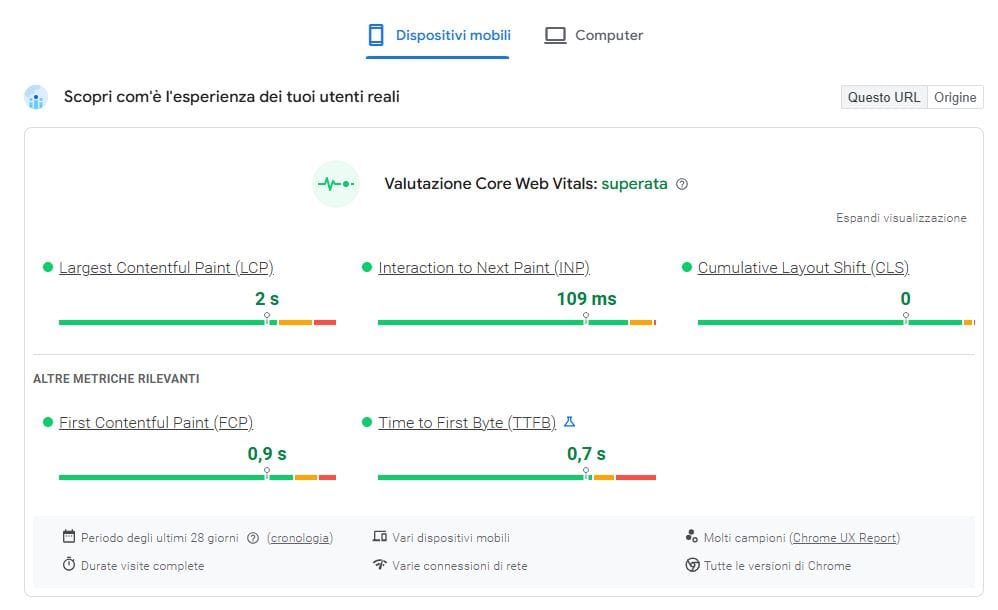
It’s worth noting that, according to an analysis conducted in 2022 on over 60,000 search results, the top ten results on Google have an average score of around 78—and fewer than 15% exceed 90. This doesn’t mean that reaching 90 is necessary; it means that those who reach 90+ have already achieved a technical result above most of the sites analyzed.
One example is the performance metrics of a website we built for kivutpois.fi
Saving Money Isn't Always Savings
If you save on hosting and put your site on a low-performance server, you'll save a hundred bucks a year—but if it doesn't pass Core Web Vitals, performance can limit visibility potential compared to technically stronger competitors.
The savings turn into a much higher hidden cost.
In my projects, I use these as minimum targets:
- 90+ in Performance
- 100 in Accessibility
- 100 in Best Practices
- 100 in SEO
But careful—and here's the part agencies almost never tell you.
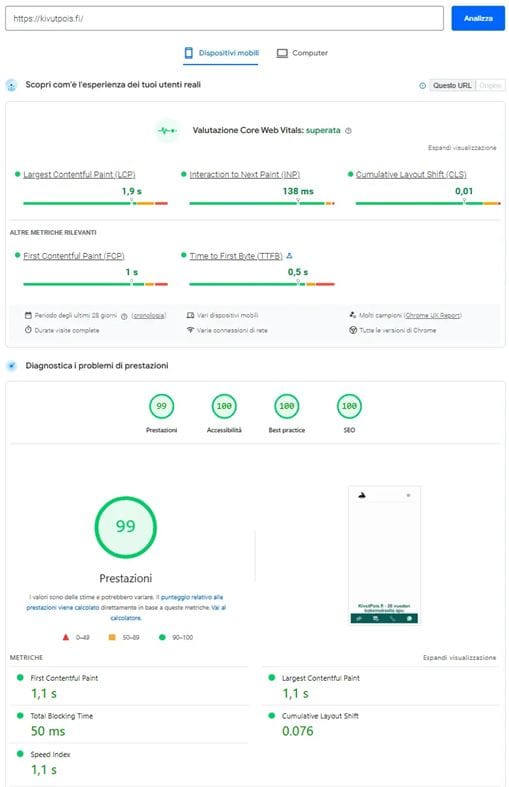
Unlike the Performance score, where a low result often points to real speed problems and can go hand in hand with worse Core Web Vitals, hitting 100 in Accessibility, Best Practices, and SEO on Google PageSpeed is often relatively easy. It means you've passed the automated checks included in those scores, not that the site is necessarily perfect in every respect.
You can have all three values at 100 even on a painfully slow platform. Performance, on the other hand, is much more affected by the site's actual speed. If the hosting is poor, performance can take a serious hit too.
And that's where both the Performance score and some Core Web Vitals can suffer.
So saving a few dozen or a few hundred bucks a year on hosting can turn out to be the wrong choice.
If you want to know how your site's hosting platform performs, ask the agency to show you results achieved with their actual sites, or go to Google PageSpeed and check your site yourself.
The Wow Factor: Where to Put It and Where Not To
A common mistake among less experienced folks is putting the wow factor at page load.
The top portion of the page—what the browser shows immediately, technically called ATF (Above The Fold)—needs to be simple, simple, simple. Forget animations, transitions, and special effects in that zone.
Unless you know how to properly optimize scripts and animations to reduce their impact on performance, skip it.
If you still want the wow factor, put it after the second section—and make sure it doesn't slow down the initial page load.
Think of the DOM as a house's foundation. First you build the foundation, then you add decorations. Anyone who does it backwards risks the house collapsing—or, in our case, hurting performance.
This is also where the challenge of cookie banners and Google Analytics 4 comes in—both can have a major impact on performance. If you know how to manage their loading properly, you can limit the impact. Otherwise, it's a variable to keep in mind when choosing the right plugin.
Interconnection: Does Your Site Talk to the Rest of the World?
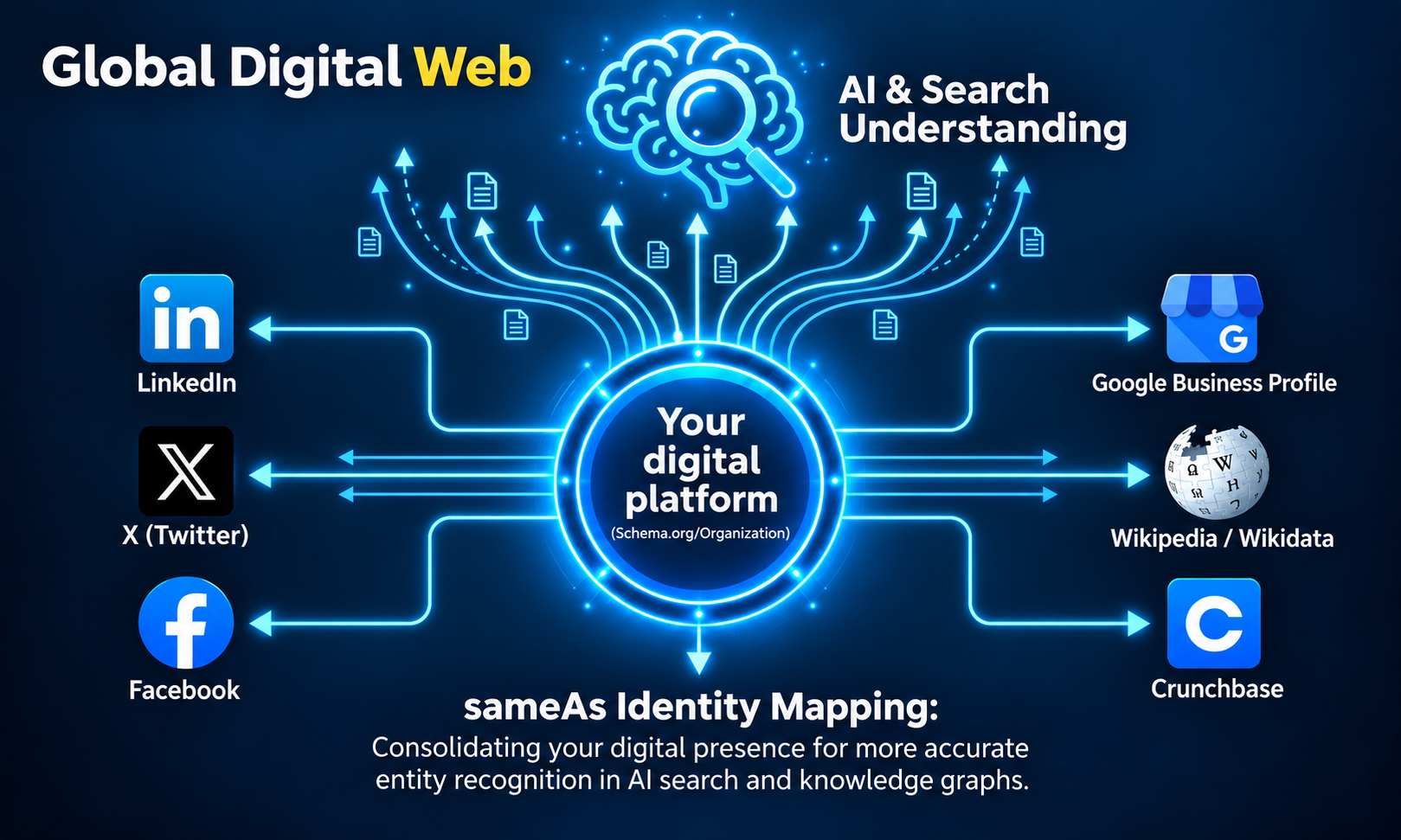
Anyone with a site needs to ask themselves a simple question: Is my site connected to my Google Business Profile? Are my social channels connected so Google understands they belong to the same entity?
This is called Entity Linking—and it's very important for GEO.
(source: What Are Entities on Google and Why They Matter for SEO — SemRush)
Imagine you're a doctor with a practice, a LinkedIn profile, a Facebook page, and a Google profile. If these "pieces" don't talk to each other, it can be harder for Google to understand that they all refer to the same person. Entity Linking is the invisible thread that helps Google understand: "It's all me."

The TL;DR: Not Just for Readers, But for AI
Do we have a summary for people in a hurry? Having well-structured, clear, and easily summarizable content can make it easier for automated systems to analyze too. If your agency never talks to you about E-E-A-T, they might not be the best solution.
The TL;DR—“Too Long; Didn’t Read”—is a clear synthesis of the page's main points.
It's not just a summary for the reader: it's also a way to make the central theme of the content more explicit.
But careful—it's not enough to write "TL;DR" and hope it works. Google doesn't require special markup for AI Overviews or AI Mode.
A small technical example of how we use it in this article:
<aside data-ai-summary="true"><p>
<strong class="ai-tldr-label">TL;DR:</strong>
Your summary here.</p></aside>
data-ai-summary is an experimental attribute we use as an additional layer in the code. It doesn't replace semantic HTML, and we can't say that Google gives it any particular advantage.
We can also include an abstract in our JSON-LD, reporting the same synthesis used in the TL;DR:
{
"@context": "https://schema.org",
"@type": "Article",
"abstract": "Your TL;DR here."
}
This way, the same synthesis is present in both the HTML content and the structured data.
E-E-A-T: What It Means in Practice for a Website
In the previous section, we've already seen what Experience, Expertise, Authoritativeness, and Trustworthiness mean. Here we'll go a little deeper and look at what information can help people evaluate these aspects.
Structured data can describe this information and connect it to the relevant entities, but it doesn't certify a site's E-E-A-T.
| Element | What visitors need to understand | How we can prove it |
|---|---|---|
| Experience | Have you personally lived what you're talking about? | Case studies, completed work, photos, testimonials, and verifiable reviews |
| Expertise | Are you actually knowledgeable enough to talk about the topic? | Certifications, qualifications, training, professional experience, and signed technical content |
| Authoritativeness | Do others recognize that person or company as an authority in their field? | External citations, published articles, awards, conferences, collaborations, and linked official profiles |
| Trustworthiness | Is the information consistent, and can you clearly understand who's behind the site? | HTTPS, real contact details, a clear privacy policy, consistent business data, identifiable authors, and verifiable information |
The most common mistake is thinking it's enough to write "Experts since 1990". That's a claim. It's much better to back it up with information that helps people verify who you are, what you've done, and how long you've been doing it.
In the JSON-LD, we can then connect this information to the relevant entities—for example Person, Organization, Article, author, @id, and sameAs—without inventing anything that doesn't actually exist on the site.
Section 4 - Deep Tech: From SEO to Generative Engine Optimization
- GEO starts from the same foundations as SEO and extends them to generative search.
- A perfect Lighthouse score is just a basic technical check: architecture, content, entities, and structured data do the rest.
- We'll look at advanced JSON-LD, llms.txt, experimental data-ai-* attributes, and some tests I'm personally running.
- We'll finish with key parameters to monitor, realistic strategies, and a final technical checklist.
Colleagues, Let's Be Real
Where GEO Comes From
Before we go any further, it's worth understanding where the term GEO comes from.
In November 2023, a group of researchers published a study called “GEO: Generative Engine Optimization”, which was later presented at the KDD 2024 conference.
The study also introduced GEO-bench, a system used to measure how visible content was in AI-generated responses. In their tests, some of the techniques they used increased visibility by up to 40%.
But be careful: this doesn't mean that doing GEO will give your site 40% more visibility. That's simply the result the researchers obtained in the tests conducted for that study.
(source: GEO: Generative Engine Optimization — Aggarwal et al.)
In 2026, a 100% SEO score on Lighthouse is a good basic technical check, not an indicator of strategy or actual positioning.
If our strategy still limits itself to H1 and H2 tags, we're leaving out a huge part of the work.
From Tags to Relationships: Structured Data Beyond the Standard
H1, H2, and well-organized content still matter. But we can also help search engines understand who the people and companies we're talking about are, and what relationships exist between them.
This is where JSON-LD graphs come in. They aren't there to force rankings, and Google doesn't require them for its AI features, but structured data remains an important tool for explicitly describing the entities found on a page.
Here's an example of more advanced JSON-LD that connects a professional to their company, their education, and the page that describes them:
{
  "@context": "https://schema.org",
  "@graph": [
    {
      "@type": "Organization",
      "@id": "https://yoursite.com/#organization",
      "name": "Company Name",
      "url": "https://yoursite.com/"
    },
    {
      "@type": "Person",
      "@id": "https://yoursite.com/#person",
      "name": "Professional Name",
      "jobTitle": "Specialist in [Field]",
      "worksFor": {
        "@id": "https://yoursite.com/#organization"
      },
      "alumniOf": {
        "@type": "EducationalOrganization",
        "name": "University or Certifying Body Name"
      },
      "knowsAbout": [
        "Skill A",
        "Skill B",
        "Skill C"
      ],
      "sameAs": [
        "https://www.linkedin.com/in/profile"
      ],
      "mainEntityOfPage": {
        "@id": "https://yoursite.com/professional/#webpage"
      }
    },
    {
      "@type": "ProfilePage",
      "@id": "https://yoursite.com/professional/#webpage",
      "url": "https://yoursite.com/professional/",
      "mainEntity": {
        "@id": "https://yoursite.com/#person"
      }
    }
  ]
}
(source: JSON-LD, AEO and GEO: Websites Understandable to AI — HT&T)
JSON-LD and the llms.txt File
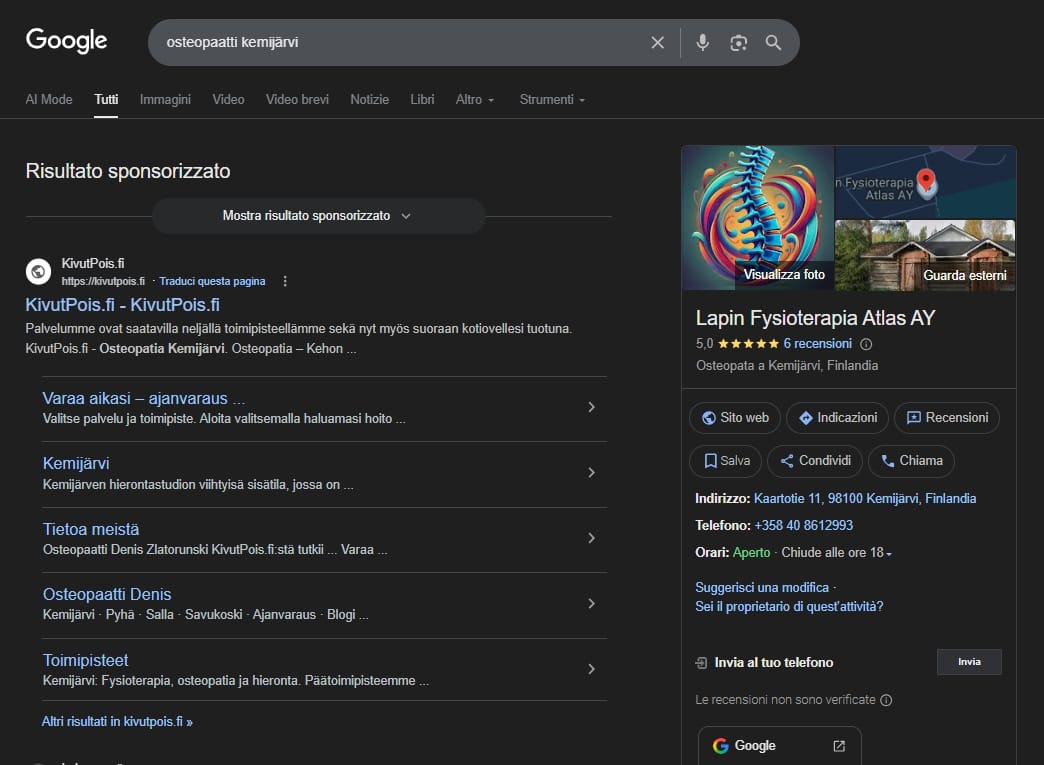
One thing that genuinely paid off was rebuilding the kivutpois.fi website. I talk about it in more detail here.
Just 12 hours after going live, I saw the pages get indexed on Google—which doesn't always happen. But what really got me excited was watching the data grow over the following week. And instead of the usual link, I started seeing structured data showing up in the search results.
So I decided to test it from an AI perspective, to see if the work had actually paid off.
I asked the kind of question a regular person would ask: "I'm in Lapland near Kemijärvi and I need an osteopath. Who do you recommend?"
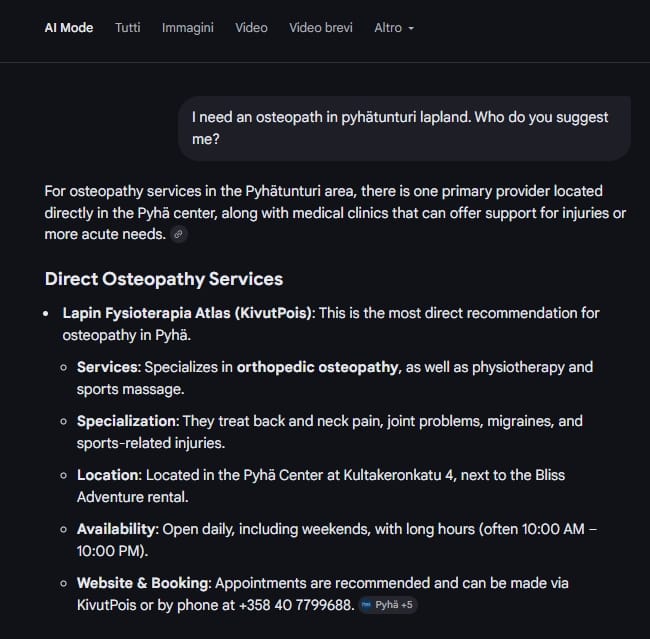
During the first week, I kept seeing the same links as always. But after about three weeks, in the tests I was running, kivutpois.fi was showing up at the top of the suggestions, right next to Lapin Fysioterapia Atlas AY—the company behind kivutpois.fi.
Even today, in my tests, kivutpois.fi often shows up at the top of AI search suggestions for other tourist destinations too, including the Pyhätunturi ski resort, where Lapin Fysioterapia Atlas AY has a clinic.
At that point, I tried something different. I asked: "What can you tell me about the page siti.italiadigitalweb.it? What JSON-LD and data-ai do you see on that page?"
That's when things got frustrating. Every single time, the answer was: "I don't see any JSON-LD on the page, or any data-ai attributes."
I tried everything—and yeah, it was frustrating. But I kept digging, and eventually I got a better idea of what might be causing it. So I'm sharing it here.
While working on the JSON-LD graphs to make them more complete and advanced, I realized there was an important difference between what actually exists on the page and what some chat tools are able to show you when they run a direct fetch.
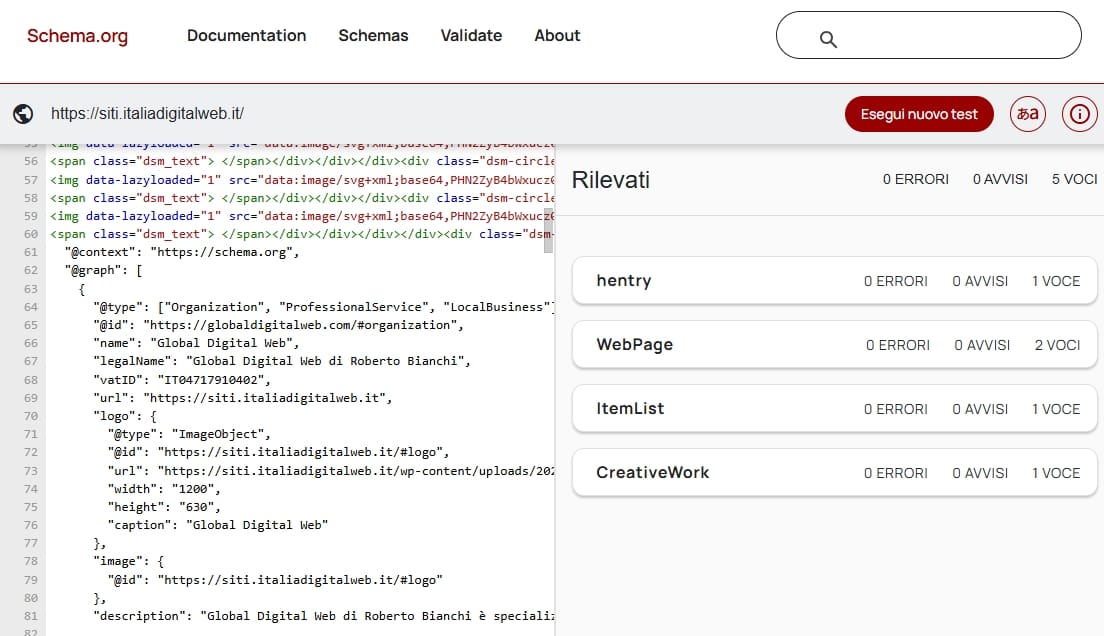
When I validate the structured data on validator.schema.org and Google's Rich Results Test, everything checks out. If I check the page source, the structured data is right there—in the <head>, written correctly, like this:
<script type="application/ld+json">
{
  "@context": "https://schema.org",
  "@graph": [
    {
      ...
    }
  ]
}
</script>
So, the JSON-LD is there. It's on the page. It's written correctly.
So… does JSON-LD not matter for GEO?
No. It does what it was designed to do: describe entities, content, and relationships in a structured way and help search engines better understand the page.
Google itself still recommends structured data as part of SEO, although it makes clear that it isn't required for AI Overviews or AI Mode.
So why is it that when I ask Gemini, Grok, or ChatGPT what structured data they see on the page, in my tests the answer is often: "I don't see any JSON-LD"?
Because what a chat tool receives when it checks a page directly doesn't necessarily include everything a crawler or search engine can retrieve.
When we ask for a search, a recommendation, or up-to-date information instead, chat systems can use their own crawlers, search indexes, and external search providers. There isn't one single path that's the same for all of them.

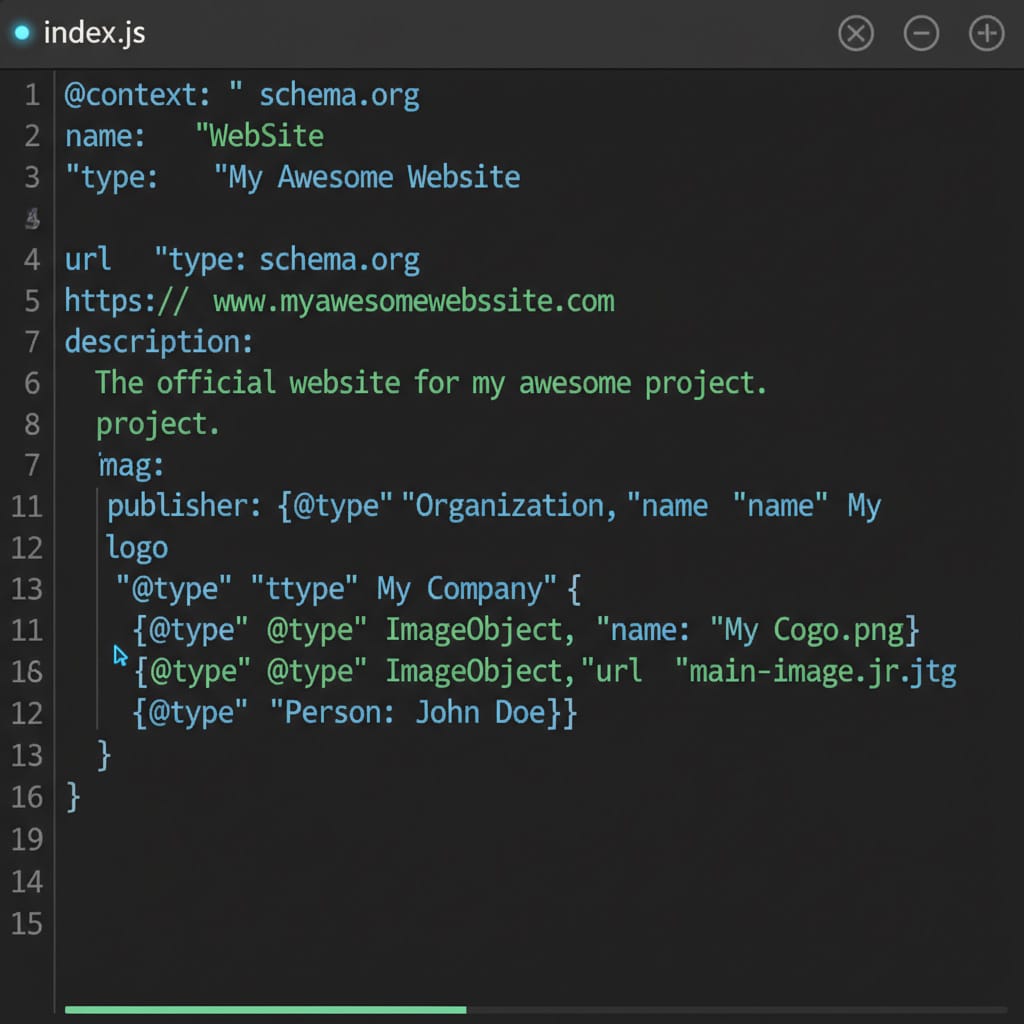
But it's a different story when I ask a chat tool to inspect a page directly and run a fetch.
In several of my tests, the version of the page returned to the chat didn't contain scripts or JSON-LD, even though they were clearly present in the original page source.
This doesn't mean the JSON-LD doesn't exist or that a crawler can't read it. It simply means that the representation of the page that reaches the chat isn't always the complete HTML we'd see by opening the page source.
And that's exactly the difference that completely threw me off in my first tests.
It's also important to distinguish between the different crawlers here.
OAI-SearchBot, for example, is the crawler OpenAI uses to help public content be discovered and shown in ChatGPT Search. It's different from GPTBot, which instead relates to the possible use of content for training.
ChatGPT Search can also use external search providers. In some OpenAI products, OpenAI explicitly documents the use of Bing, but that doesn't mean Bing is the only route through which a page can make its way into an answer.
I can't, however, claim that OAI-SearchBot specifically uses JSON-LD, because OpenAI doesn't currently document that.
The important point is something else: the fetch we see inside a chat and the process crawlers and search engines use to collect information from the web are two different things.
(Source: OpenAI — ChatGPT Search)
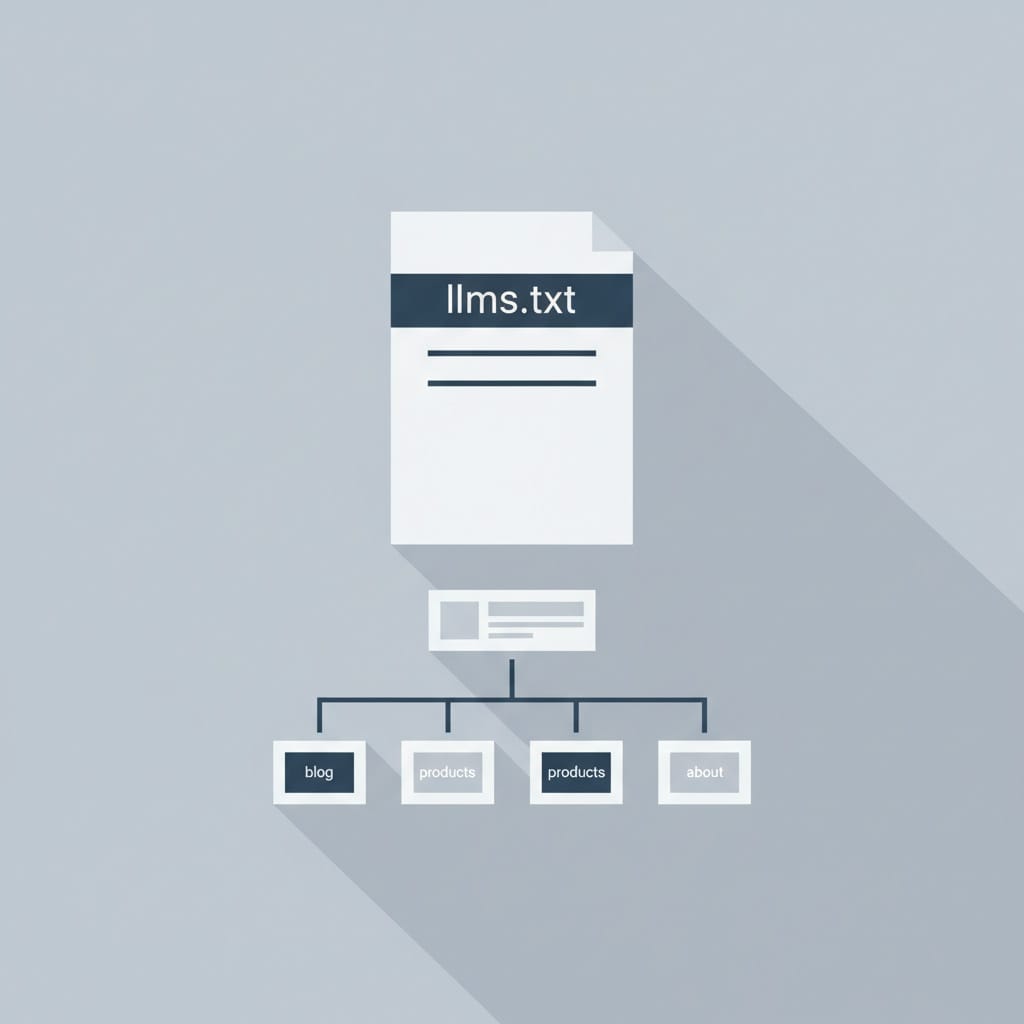
The llms.txt File
There's also a newer tool that I find particularly interesting: llms.txt.
It's an emerging convention and, in its most common form, the file lives in the root of your website—just like robots.txt.
It's written in Markdown and is designed to give LLMs and agents a simple version of the site's structure and its most important resources.
Google Search has made it clear that it doesn't use llms.txt for ranking. But Chrome Lighthouse has now added a check for the file in its Agentic Navigation section.
So I don't see it as a replacement for SEO, the sitemap, or structured data. I see it as an additional layer for systems that decide to use it.
Version 2 Arrived on August 10, 2026
In the meantime, the llms.txt proposal has evolved. On August 10, 2026, it was updated to version 2, which no longer focuses only on an llms.txt file in the root of the site.
The new version also allows llms.txt files inside individual sections of a site and proposes making Markdown versions of pages available, for example through an index.md file.
The idea is simple: an agent can use llms.txt to understand where to look for information and then follow links to the pages it needs, possibly using a Markdown version that's easier to read than the full HTML.
Version 2 also introduces links that can tell agents where to find the Markdown version of a page and its related llms.txt file.
(source: llms.txt v2)
Some plugins and platforms have started generating llms.txt automatically.
The problem is that many files generated this way end up being mostly a list of the site's pages with a title, URL, and not much else.
That's already something, but when it's written by hand it can become much more useful.
In the llms.txt file I created for kivutpois.fi, for example, I don't just list the pages. I explain:
- which company is the legal entity and which name is the public brand;
- what the locations, services, and professionals are;
- which pages are the main sources for each type of information;
- what relationships exist between people, services, and locations;
- which information must not be inferred or invented.
That's the difference I see between a simple automatically generated index and an llms.txt file written with the people—or systems—that will actually interpret the site in mind.
Something I Can Actually Measure Now
When I started using llms.txt, it was still an experiment that was difficult to verify.
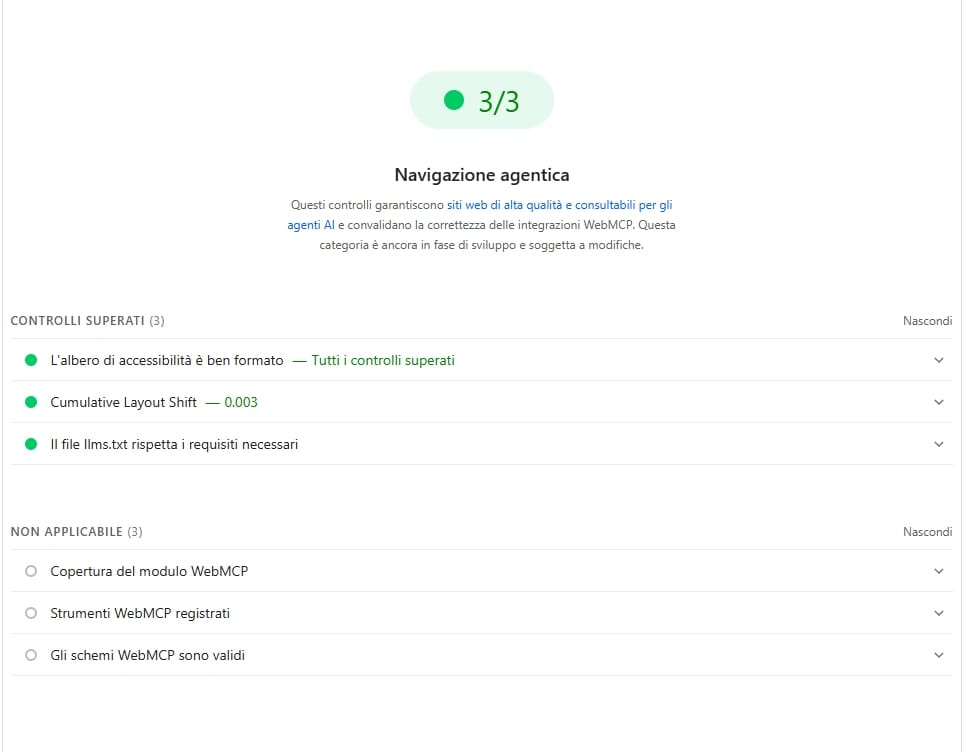
Today, when I check some of my sites with PageSpeed, in the Agentic Navigation section I also find this check:
"The llms.txt file meets the necessary requirements."
In the test you can see in the image above, the site passes all three available checks: 3/3.
This doesn't prove that llms.txt makes a site rank higher on Google or that every AI system uses it. But it does prove something very concrete: the file has now made its way into experimental technical checks designed for agent navigation too.
And What About data-ai? I'm Still Testing It
When I started experimenting with data-ai attributes, between October and November 2025, I'd found and cataloged around fifteen of them.
By August 2026, my registry already contained 17 with verified public use, plus many others found in specific products and implementations or still waiting to be verified.
Google clearly says that no special markup is required for its AI features. And that's fine.
But the question I asked myself was this: if these attributes weren't useful to any system, why do I keep finding new ones being used by different products? The fact is, today we know that some products really do use them.
The point is that each system can use them for its own purposes. There still isn't a universal vocabulary.
In my tests, I've also noticed that sites where I've used this structure get cited more often in AI responses. I can't prove that this is because of the data-ai attributes. It could be a coincidence, or it could be the result of everything else that was done on the site.
But the behavior has repeated itself enough times to make me keep testing them.
That's why I use them as an additional layer when they have a precise meaning, without replacing semantic HTML, accessibility, or Schema.org. If some of these markers become more important in the future, at least I won't have to start everything from scratch.
The Next Test: A Markdown Version of the Pages
Here I'm moving into an experiment I still have to run and that, interestingly enough, goes in a direction similar to the one suggested by the new version of llms.txt.
Cloudflare, for example, already makes its documentation pages available in Markdown too. By adding /index.md to a page URL, you can get a version that's much easier for an AI agent to read.
The idea interests me because, in my tests, not every chat tool is able to retrieve HTML, scripts, JSON-LD, and Markdown files in the same way.
What I've noticed instead is that TXT files are read very easily, even when the content inside them is written in Markdown.
That's why over the next few months I want to run a slightly different test: place an index.txt version alongside the HTML pages, with the same factual content written in Markdown and the important relationships made easier to read.
The index.txt format isn't part of the llms.txt v2 proposal, and I don't know yet whether it'll bring any benefits. It's an experiment.
The important thing is that AI systems aren't given information that's different from what people can see. The format changes, not the reality we're describing.
Once I have enough data, I'll publish the results and we'll see whether it was worth it.
Key Parameters to Monitor
To understand whether the work is producing results, these are the data points I focus on most today:
- Search Console: impressions, clicks, and queries. Data from AI Overviews and AI Mode is included in the total for the Web search type; it isn't a separate measurement of AI citations.
- Real Core Web Vitals: especially LCP, INP, and CLS measured on real users—not just in lab tests.
- Structured data: markup validity, errors, and rich results that are actually available.
- Traffic and citations from AI: referrals from ChatGPT and other systems, together with periodic tests.
Concrete Strategies: What Actually Works
Let's be clear: no miracles. Anyone promising immediate or guaranteed results is someone I'd be very careful with.
A good SEO and GEO setup can create a very solid foundation, but the work doesn't end when we publish the site. In fields where people are constantly looking for information, continuing to publish genuinely useful content can make a big difference over time.
(source: Generative engine optimization (GEO): How to win AI mentions — SearchEngineLand.com)
Interestingly, memes and jingles have started appearing on social media promising to get a site to top AI positions with just a few clicks.
Just a few days ago Diletta Beligotti, my colleague and expert Social Media Manager, wrote to me:
"Hi Roberto, I'm monitoring agency ads on Facebook and look what's showing up. They're starting to sell AI positioning to businesses."
My immediate response was:
"Yeah, but the way they tell it in the ad is pure snake oil."
To actually get mentioned by AI, there can be a ton—an absolute ton—of work behind it.
So be extremely careful with promises of easy or guaranteed results.
Often these are clickbait ads with vague or misleading information, like:
"My small business gets XX new customers a day thanks to ChatGPT," accompanied by promises of similar results with a few clicks.
I'd stay away from these promises.
If instead you want to invest in a serious strategy to increase your chances of being found and cited by AI too, below I'll explain what the work actually involves.
Editorial Plan and Quality Content
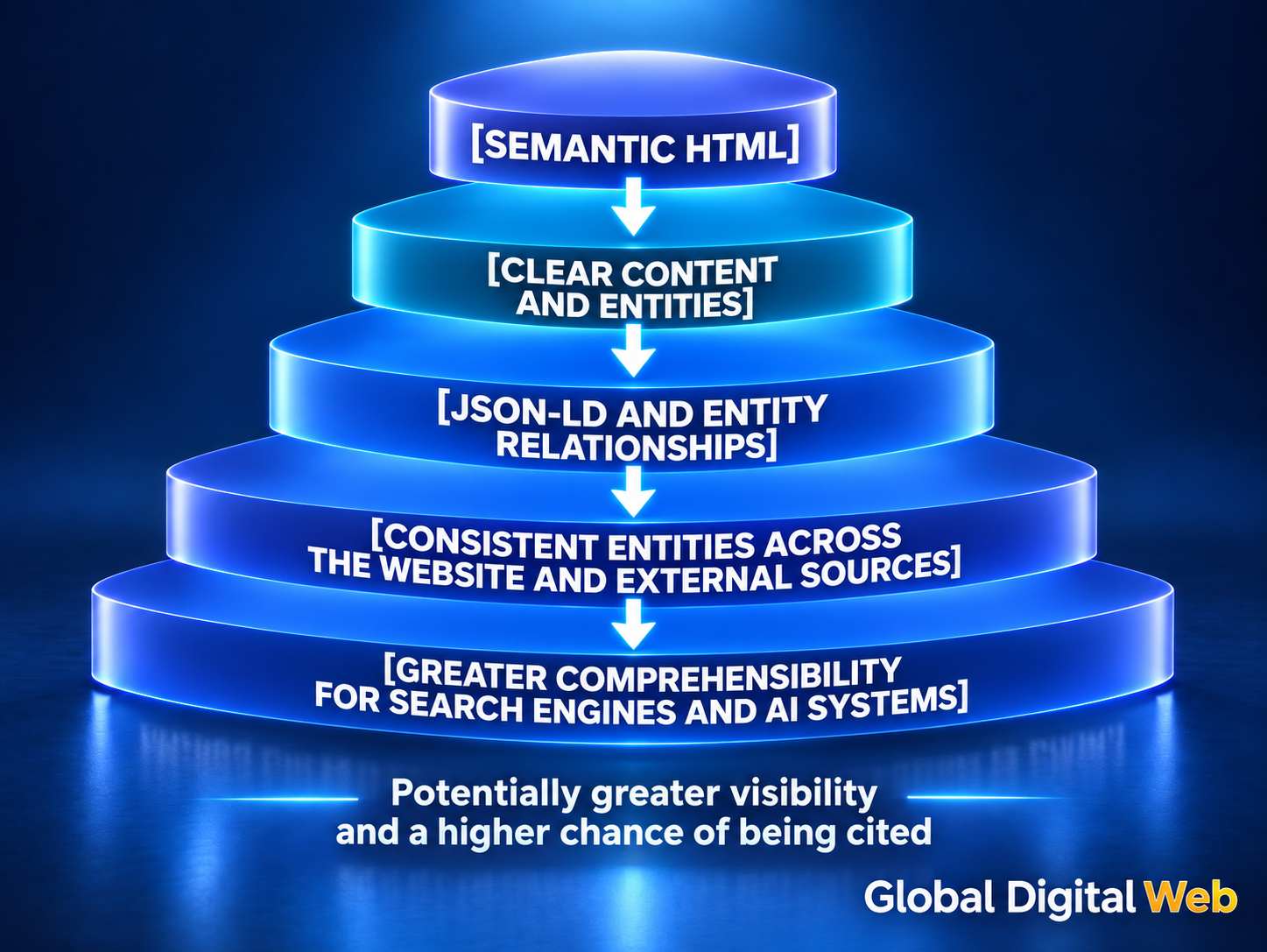
The foundation is always the same: a well-built platform that's fast, technically solid, and has consistent structured data that helps search engines better understand content, entities, and relationships.
But this is just the foundation.
A platform, even well-developed, if it contains very little content will inevitably have fewer chances to answer the many questions people may ask in its field.
Pages need to tell something useful. They need to offer real value and answer concrete questions. A simple "showcase site," however well made, will rarely be able to cover all these topics.
Anyone seriously intending to emerge in the local services landscape can work on:
- a site with coherent, well-implemented structured data;
- content that demonstrates real experience and expertise;
- consistent information across the site and other digital properties;
- experimental attributes like data-ai-* when they're relevant and purely additive.
The data must be cross-referenceable and verifiable. Consistency between content, technical structure, and online presence is important.
But we can't determine in advance how many weeks or months it'll take before a site gets cited by an AI or moves up for a specific search.
And this is where, for many projects, the editorial plan comes in.
It's not about publishing random articles or content written only to intercept certain keywords.
It's about offering a real service to your audience.
An effective editorial plan is born from people's real questions, from doubts that emerge in daily life, and from concrete problems seeking solutions.
If you're a professional in the medical field, for example, you can regularly analyze how to prevent, manage, or recognize certain conditions.
Whatever your field, the key is using your experience to help—and really help.
This Is the Real Secret!
Many make the mistake of focusing exclusively on acquiring technical authoritativeness or external links, forgetting that a quality platform must first and foremost be useful to people.
For a moment, let's set aside algorithms and keywords.
Let's put people at the center.
When attention is directed at human beings, articles have a much better chance of being genuinely useful and shareable.
Naturally, the expert will need to focus on producing genuinely valuable content.
It will then be the developer's or technical team's job to integrate it correctly into the platform, structure it clearly, and add the relevant structured data.
Base Strategy: Four Content Pieces per Month
Four content pieces per month can be a sustainable working pace for many projects, but it isn't an SEO or GEO rule imposed by Google.
What's included:
- Semantic SEO on every piece;
- custom structured data when relevant;
- technical optimization and internal linking;
- TL;DR and data-ai-* attributes when they genuinely make sense.
Indexing times depend on the domain, crawling, the industry, and many other factors.

Professional Strategy: Ten Content Pieces per Month
What's included:
- Everything in the Base Strategy
- Monthly report on rankings and performance
- Higher publishing frequency
- Broader semantic coverage
Ten content pieces per month also represent a volume of work, not a formula that guarantees faster results.
What Really Affects Timing
| Situation | Possible Effect |
|---|---|
| New domain | It may take longer to be discovered, indexed, and build a history of signals. |
| Established domain | New pages may be discovered and indexed more quickly. |
| Highly competitive field | It generally requires more work to gain visibility. |
| Site with technical or crawling problems | It can slow down indexing and visibility regardless of content quality. |
Business Strategy: Twenty Content Pieces per Month
What's included:
- Everything in the Professional Strategy
- Detailed monthly report + monthly strategy call
- Advanced competitor monitoring
- Continuous data-driven optimization
Here too, twenty content pieces per month represent an operational volume. They don't automatically mean faster indexing, rankings, or AI citations.
Important: This work can be complementary to Google Ads campaigns. Ads can be useful when you need immediate visibility, while SEO and GEO work toward different goals and on much less predictable timelines.
What It Really Takes to Make It Work
A serious SEO/GEO strategy may require work on several fronts:
- a technical side for SEO, crawling, structured data, and optimization;
- a subject matter expert who produces or verifies genuinely valuable content;
- consistency in keeping the site updated when the field requires it.
There is no universal minimum number of articles per month, and there is no guaranteed period after which results will arrive.
This kind of work is generally more expensive than basic SEO because it requires many more hours of analysis, development, verification, content, and monitoring. The real cost depends on the project, the number of pages, the entities involved, and the site's starting point.
That's why I prefer not to give standard prices: first, you need to understand what actually needs to be done.
Seven Common Mistakes to Avoid
1) Thinking an SEO Plugin Is Enough
Yoast SEO and RankMath are excellent tools, and they do much more than manage titles and meta descriptions. But a plugin alone doesn't build a strategy. The real difference comes from the site's architecture, the content, and the work behind it.
2) Believing Speed Is Everything
A fast site is fundamental, but it must clearly communicate who you are, what you do, and why the information you publish is trustworthy.
3) Not Connecting Digital Properties
Website, Google Business Profile, social media, and other online properties should provide consistent information. Structured data and properties like sameAs can help connect entities when relevant.
4) Publishing Generic Content
Generic content that doesn't add real experience or useful information has little to offer. A detailed case study with technical data and actual measured results is worth much more.
5) Ignoring Real Core Web Vitals
Many focus only on lab tests (Lighthouse). Core Web Vitals, on the other hand, also use field data collected from real users through CrUX. If your site performs well in the lab but poorly for actual users, it's worth finding out why.
6) Not Measuring Results
If you don't monitor Search Console, organic traffic, AI referrals, and the results for your most important queries, you're not doing either SEO or GEO.
7) Expecting Immediate Results
SEO/GEO is a marathon, not a sprint. Be wary of anyone who guarantees the top position by a specific date. Ads are a different story because they buy visibility as long as there's a budget.
Checklist: 10 Things to Verify on Your Platform
- Performance and Core Web Vitals: use PageSpeed Insights and check both lab tests and, when available, real-user data.
- Structured data: validate the markup with Schema.org Validator and, when the type is supported by Google, with Rich Results Test. Make sure the data actually describes what appears on the page.
- Consistent entities: company name, people, addresses, phone numbers, Google Business Profile, and official profiles should all describe the same reality.
- Crawling and indexing: check Search Console, robots.txt, the sitemap, and make sure important pages are actually accessible to crawlers.
- TL;DR and structure: on long pages, a clear summary can help the reader and make the content structure more explicit. But it isn't a guarantee of an AI citation.
- Mobile: actually check the site on a smartphone. It needs to be readable, easy to navigate, and fast enough.
- HTTPS and security: the site should use HTTPS correctly and have no certificate errors or mixed content.
- E-E-A-T: are there identifiable authors, real experience, verifiable qualifications, case studies, or other concrete proof? Or just "we've been the best since 1990"?
- llms.txt: if you use it, make sure it's valid, up to date, and genuinely useful. You can also check it in Lighthouse's Agentic Navigation section.
- AI test: ask ChatGPT, Perplexity, Claude, or other systems about your company. Treat it as a diagnostic test, not a scientific measurement of your rankings.
FAQ: The Most Common Questions About GEO
How long does it take to see results with GEO?
There is no fixed timeframe.
An established domain that's already regularly crawled can show changes much sooner than a brand new site, but it depends on the industry, the competition, the state of the site, and the type of search.
The same applies to AI citations: there is no number of weeks or months we can guarantee.
Consistency helps, but there isn't a rule requiring four content pieces per month either.
Is my WordPress site already optimized for AI?
It might be, at least partly, but you can't tell just because it uses WordPress, Yoast, or RankMath.
Yoast and RankMath already handle many important features: sitemaps, metadata, schema, and other SEO configurations.
But that doesn't automatically mean the site has good entity architecture, suitable content, custom structured data, or that it's easy for AI systems to use.
You need to look at the site as a whole.
Do I need to rebuild my website completely, or can I update it?
In most cases, you can update the existing site.
You can improve structured data, content, connections between entities, accessibility, performance, and other technical areas without necessarily changing the design.
llms.txt and any data-ai-* attributes can also be added later if the project decides to use them.
Naturally, it depends on how the original site was built.
What Is JSON-LD and Why Is It Important?
JSON-LD is one of the formats used to add structured data to a web page.
Structured data isn't there to "force" rankings, but it helps search engines understand more precisely who you are, what you do, and how the information on the page is connected.
It's the difference between saying "I'm good" and providing information that can be identified and verified.
Can AI hurt my business if I don't optimize?
Rather than hurting your business directly, the risk is being less visible when someone asks a question in your field.
If someone asks "Where can I find a [your service] in [your city]?", the system has to decide which sources to use and which businesses, if any, to suggest.
If it finds clearer, more complete, and more verifiable information about your competitors, it might choose them instead of you.
It's like having a store on a street where the signs aren't very clear: the store exists, but it's harder to find.
How much does implementing GEO cost compared to traditional SEO?
It generally requires more work than a basic SEO setup, so it can cost more.
You need to understand how many pages there are, how many entities need to be managed, what structured data already exists, how much work the content needs, and how complex the platform is.
That's why giving a standard price doesn't make much sense.
The cost needs to be evaluated project by project, based on the work that's actually required.
Does GEO replace SEO?
No. GEO doesn't replace SEO: it's an evolution linked to the way information is now searched for and used by generative systems too.
The foundations remain the same: a fast and accessible site, useful content, clear semantic structure, consistent entities, and reliable information.
The difference is that today we also need to think about how that information can be understood, connected, and used by AI.
Is the llms.txt file actually useful?
Google has made it clear that llms.txt isn't a ranking factor and isn't required to appear in its AI features.
But that doesn't mean it's useless. Some systems and tools for agentic navigation have started using it or checking whether it's present.
How it's written makes a difference too. An automatically generated llms.txt file may do little more than list the pages on the site. A hand-written one can instead explain identities, services, people, locations, relationships, and which sources to use to find the correct information.
That's what I'm doing on my sites, and I'll keep checking the results.
Are data-ai-* attributes necessary for GEO?
No. Google doesn't require data-ai-* attributes for SEO, GEO, AI Overviews, or AI Mode.
But I'm still testing them.
When I first started looking into them, between October and November 2025, I'd found around fifteen. Since then, many more have appeared, and they continue to be used in different products and systems.
In my tests, I've also noticed more AI citations for some sites where I'd implemented them. I can't prove that this is because of the data-ai attributes: it could be the result of everything else that was done on the site.
But it interests me enough to keep testing them. So I see them as an additional, experimental layer, not a replacement for semantic HTML or structured data.
If ChatGPT can't see my JSON-LD, does that mean it isn't working?
No. And that's something I discovered personally after a lot of testing—and a fair amount of stress.
I kept asking chat tools to inspect a page and being told they couldn't find any JSON-LD. Then I'd open the source of the exact same page, and the JSON-LD was exactly where it was supposed to be.
The reason is that the version of a page retrieved directly by a chat tool doesn't necessarily include all the HTML available to a crawler or browser.
So if a chat tool can't show you the JSON-LD during a fetch, it doesn't automatically mean the structured data doesn't exist or is wrong.
How can I tell if AI systems have the right information about my company?
A very simple check is to ask AI systems the same questions a potential customer might ask.
For example:
- "What can you tell me about [company name]?"
- "What services does [company name] offer?"
- "Where is it located?"
- "Who works at this company?"
- "Where can I find a [your service] in [your city]?"
I run these tests periodically on the sites I build too.
It isn't a scientific measurement of rankings, because answers can change between different systems and over time. But it's a very simple way to find incorrect information, confused entities, or data that AI systems still aren't connecting properly.
Do I need to create different content specifically for AI?
No. We shouldn't create one reality for people and another for AI.
The information needs to remain consistent and verifiable.
But we can represent the same data in different ways: HTML text for people, JSON-LD to describe entities and relationships, llms.txt and, where it makes sense to experiment with them, Markdown or TXT versions that are easier for some agents to read.
Over the next few months, I also want to run some tests with index.txt versions of pages, written in Markdown but containing the same information available on the site.
The format changes. The facts shouldn't.
A Final Note
Naturally, there's enough material here to write entire books on the subject.
When I started working on this guide, in March 2026, I could find plenty of scattered information in Italian, but very few resources that brought SEO, GEO, structured data, AI, and the technical side together in one place.
In the meantime, things are changing fast. Some of the tools I talk about here practically didn't exist when I started writing it, and others continue to evolve month after month.
That's why I see this guide as a work in progress. I'll keep updating it as I get new data and, above all, new results from the tests I'm running on my sites.
I hope you found it useful.

About the Author
With more than three decades in digital tech and education, Roberto Bianchi is dedicated to breaking down complex technological concepts into clear, actionable insights.
His global journey — from Finland to the U.S. and Kenya — has shaped a uniquely human-centered approach to technology, making it accessible and practical for everyone.
Key expertise:
- SEO and Generative Engine Optimization
- Web development
- Digital marketing
- Training and mentoring
- Content creation
Roberto is the founder of Global Digital Web, focused on making technology understandable and useful in everyday life.